I do sometimes indulge in a little bit of political letter writing- it's good for the spleen I believe. There was a post on the local tory blog that I picked up via twitter, and it pissed me right off, so I've written to the local tories. And this is what I said....
Dear Sir or Madam,
It has come to my attention that the Brighton Tory web site is currently publishing a story casting aspertions upon the probity of the Green MEP for the south east region, Ms Caroline Lucas. The article (http://www.brightonandhoveconservatives.com/news/61/) seeks to equate the high costs of administration that Ms Lucas's office runs is in some way analogous to the indiscriminate largess indulged in by MPs of all parties at Westminster, and seeks further to imply that her assertion of honesty and of being distinct from the rampant "troughing" of Westminster representatives is in some way "disingenuous".
It's my belief as an independent and non-aligned voter, that you are being rather "disingenuous" yourselves. Ms Lucas's expnses seem to me to be well justified in her role as a representative for a large swathe of England, and one of the few representatives the many thousands of British Green voters have in Europe. I understand that she is an active member of many committees, is right at the core of the European coalition of Green parties, and I can personally testify to her excellent communication with constituents like myself. In fact, in this last regard, she and her staff are streets ahead of your own parties incapability to so much as respond to directly submitted requests and comments by email to representatives. In short, she works very hard, and does a damn site better job that your sorry lot.
At a time when the Tories in Europe are sidling up to the worryingly reactionary fringe parties, instead of being at the heart of European centre right parties, I think it's high time you took a long hard look at your own policies, process and responsibilities to your constituents. As a party you are thoroughly tarred with the Westminster expenses scandal- you are in fact corrupt, and recognised as such. Simply spitting false allegations against your opponents does nothing for you or for the level of political debate.
I have take the opportunity to copy this letter in to the Tory representatives in the European Parliament- my hope is that you'll all take this opportunity to reconsider this approach to the politics of muck spreading.
Yours in some considerable disgust,
Ant Miller
This is going to:
carolinelucas@greenmeps.org.uk, daniel.hannan@europarl.europa.eu, office@nirjdeva.com, richardjames.ashworth@europarl.europa.eu
Sunday, June 14, 2009

Tuesday, June 09, 2009
Update in the Pro stuff
A quick update on the last post- the process of setting up the blog and getting editorial sign off is underway, but not by any means completed. This also means of course that there remains plenty of opportunity for you gentle readers- yes, both of you- to let me know what sort of thing you'd like us to put on the blog.
So, point us at great other blogs, give us leading topics to explore, pose us perculiar and intriguing questions, or just ask us straight forward questions. I cannot promise that the new blog will be able to address everything, but your queries will help us set the right tone. And if I can't answer there, I might be able to here.
So, point us at great other blogs, give us leading topics to explore, pose us perculiar and intriguing questions, or just ask us straight forward questions. I cannot promise that the new blog will be able to address everything, but your queries will help us set the right tone. And if I can't answer there, I might be able to here.
Monday, June 08, 2009
Taking Things Pro
This is almost one of those blog posts one shouldn't write- as in, one that you write because you haven't written one for ages. Kind of a 'contractual obligation' blog post. Except it isn't really, I have no obligation to post. Not yet. Will soon.
Yes, that’s right, I might soon be blogging professionally, and at that point this whole lovely friendly process of punting my thoughts out to be ignored by the world will become a proper millstone. Or a more disciplined and hence efficient process.
The blog we’re talking about is a proposed BBC R&D one, to sit alongside the excellent efforts of the BBC RAD blog, the Radio Labs, Journalism Labs and the Internet blog itself, not to mention the Backstage blog. All this public relaying of information can seem a little overwhelming, but on the other hand, there’s a lot of BBC and even more public, so a profusion of communication is to be expected, and perhaps encouraged.
NOTA BENE: Extensive internal BBC review and approval is required before this goes ahead, so it's far from a done deal.
Right now we are plotting out the first few months of posting and trying to ensure we get a good spread of coverage and aim at the right level for our interested parties. Some people will be generally interested in what we’re up to, but not particularly technically minded, others will be fellow engineers and broadcast specialists fascinated by our work’s most technical elements- pitching at the right level for all will be a challenge. And that’s before we get into the confidentiality/ patent protection/ intellectual property management tangles of what we can and can’t talk about.
The R&D blog will initially sit on its own page like other blogs, but before too long it will form a core element of a refreshed public web presence for the department. We’re finishing up the initial requirements at the moment, with help from the lovely people at Howell Wong Costello, and I’d like to take this opportunity to thank Rain Ashford for her tremendous efforts to get this up and running. Rain will soon be heading back to BBC Learning after a year on Backstage and in R&D and we’re sorry to be loosing her- Cheers mi dear! Rain also produced much of the R&D TV output, including the whole of the Maker Faire segment in the latest edition, for which we're very grateful.
AAaaaand finally, just because I think a blog post is better with a picture, here’s something I knocked up tonight to stick on our office door, because I was bored with the usual office layout diagrams. Created in Lego Digital Designer. Go play

Thursday, May 14, 2009
Trying Prezi at Thinking Digital

Whilst Alex was polishing off what turned out to be an excellent presentation for the afternoon session at Thinking Digital, I struggled on with Prezi . This is a fascinating tool for creating flash based presentations, but I think I need a good deal more practice with it, and a lot more design nous, in order to do presentations that actually look good rather than just weird. It's also quite easy to accidentally get things in the wrong order, and it's ironically quite hard to get an over view of the whole presentation and be sure you've included all you want to (I left out my flickr CC attributions! Web Crime!). And of course like any new toy it's an utter time sink- eating up perhaps eight hours to rehash a presentation I mostly had already got prepared and written an up and have already given a dozen times or more. Still, I will probably persist for a little while longer, and may even splurge on the stand alone version.
The free version is fully functional but you have to be online to use it. In
Being able to work offline would be a bonus with my commuting needs, but I'm not sure the branding freedom you also pay to get is actually worth it. OK, I get annoyed with D.O.G.s as much as the next person, but actually, using something this new and different it's helpful right now to have a little flag in the corner of the screen so people can see what I'm using- half the questions after my presentation were along the lines 'how did you do that- what software was it?' and I'm sure it would have been more if I hadn't pointed out the Prezi logo on screen.
This brings me in a round about way to the question of whether it worked, as in, did people get the message? In essence, I think it did work ok. My audience seemed attentive if not exactly enraptured, and I got a laugh and a couple of chuckles from three of the five humour points in the talk. It was a 15 minute slot at the end of a long (and late running) session- I was sixth of six presentations, and I was about two hours into the program as it ran. That’s not to say it was a hard crowd at all- they were switched on, all paying, and very intelligent and engaged, and all the other presenters had been excellent, entertaining and often profoundly motivational. So in all this, my tale of a BBC Micro for the 21st Century, as told through a spinny flash animation with a few pictures and a short film clip, worked well.
Another quick sidebar- in the end I didn't embed the video. This is because I only wanted to play a short part of the overall file, and I didn't have the kit handy to edit it down. Putting the whole clip into Prezi, online, would have turned it into a huge file and radically slowed down the whole save and download process. I think, if you're going to embed video, you need proper edit (and transcode) handy, and it's going to be easier to use the stand alone version of the software.
On stage I found it a very different experience to 'drive' compared with the way I usually use PowerPoint. In spite of it being a graphical 'look', the labourious online upload, especially on a flakey web link, meant that I ended up with a predominantly 'texty' rather than picturey presentation. All those text elements, instead of sitting in big chunks per slide, had their own, individual triggers and screens, so the talk bounced along with a new movement (and me clicking it) every 30 seconds or so. And then, when I did 'pop out' into one of my 3 minute rants, that seems a bit less organic to the whole piece (at least to me). I guess I'm just very used to (and bored with) powerpoint- anything else is going to take time to learn, and until I crack it, it's going to be intrucive into the presentations, and the creative process.
Love it though!
Blinking Digital
To my great shame I only spent a half day at this year's Thinking Digital conference, Herb Kim's intellectual gymkhana on the banks of the Tyne . I am profoundly grateful to have been able to join his role call of luminaries for the one afternoon and for the dinner too though.
Anyway, all in all a great session- thanks so much to Herb, the theatre staff, and all the Thinking Digital crew. That night's dinner was mind blowing too- but that's for another post!
I actually turned up a little early for the event so spent the morning trying to polish off my presentation at the cafe at Baltic in the sparkling company of Alexandra Deschamps-Sonsino, co-founder and CEO of Tinker.it. Alex is a profoundly cool and intelligent person, and she's probably forgotten more about the people and places around the digital culture in the
Thence to the Live Theatre to register, and meet our fellow presenters for the afternoon session. The first session was streamed, with Social Media in the main theatre, Practical Wisdom back over at Baltic, and The DIY Gadget session upstairs in the Live Theatre, hosted by the BBC's own Ian Forrester, and with yours truly one of the six presenters.
My fellow presenters are an excellent bunch:
- Alex I've already mentioned- she gave a great overview of Arduino, and her company's role in it, and ran through a load of the coolest projects they're working on, plus giving an excellent socio-philosophical grounding to the importance of the technology.
- Adrian McEwen of MCQN ran through more of the hacker projects he's been working on, including a live demonstration of the bubbleduino, which was reacting live to tweets of the event by spattering our guest of honour with detergent (he took that very well).
- Richard, Stuart and Dave of Jam Jar Collective- aka the Friispray crew- then gave a brilliantly energetic three hander presentation of their project, giving a massive tip 'o the hat to Johnny Cheung Lee, the previously mentioned guest of honour- I think they were a little nervous that their hero was sat front and centre in the audience (slightly spattered with detergent). I've seen friispray a few months ago, and it's great to see not only how they're developing the technology, but also using it in really important and original contexts; club nights are fun, sure, but in education environments for kids with learning difficulties their tech can be a transformative and important step forward, making a very real difference.
- Andy Huntingdon then followed with a spectacular and pretty wonderfully noisy demonstration of his projects that use low power embedded computing to turn everyday objects into rhythm sequencers. His tappity boxes have a great sense of the dramatic built in- the three second lag makes every use an act of knife edge anticipation.
- Ken Banks then presented his revolutionary SMS hub software, FrontlineSMS- I mean revolutionary very specifically. Ken's software allows anyone with a phone and a pc to set up a powerfull SMS communications hub, and it's being used around the globe to dramatic, life changing, culturally and politically significant ends. It is the engine of revolution in many areas, and saves lives because it allows communication and peaceful activism to be more powerful than riot and violence. He's such a sweet guy too- genuinely moved by the way that people worldwide have run with the tools he's made and crafted a better future for themselves and others.
- Me- I did the usual schtick about a BBC Micro for the 21st century- reviewing the old micro, how and why it had come about, and then exploring what the modern, equivalent challenges are, and then exploring the whole culture of makery hackery, the culture my co-speakers had been propounding, to see how today, the best way to acheive analogous goals would probably be to aly ourselves closely with all these guys, to support them, help them and foster a wider cultural uptake of their ethos. (One day I'll do a post about that!)
Anyway, all in all a great session- thanks so much to Herb, the theatre staff, and all the Thinking Digital crew. That night's dinner was mind blowing too- but that's for another post!
Friday, May 08, 2009
On Having Finished Anathem
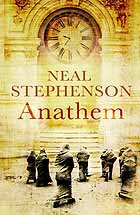
I very rarely post about books- largely because I read such a shamefully small number of them. For some reason about three years ago I put down a book about half way through, and found everything difficult to get into since. For the next year I only read newspapers, magazines and the occasional graphic novel (best one's I read then, and they were great, were Red Son, Wanted (not bothered with the film, it was blatantly miss cast) and Top10 (which was genius in the Steve Bochco mould)). This Christmas past though I got a few books, and amongst them was Anathem, the staggeringly long tome from Neal Stephenson- a Sci Fi author who appears to be accruing 'importance'.
To limber up as it were, I had a read of Greg Egan's Diaspora- a terrifically exciting and heavily intelligent book, packed full of complex ideas of the fundamental nature of humanity, the self, and the mathematical wonders of this and other universes. Now, Egan’s work has been recommended to me by a few people over the years- all of whom I have recognised as being significantly cleverer than me, and wall of whom have raved not just about his eminently readable prose and nicely rounded characters, but also about the truly challenging intellectual leaps he invited his readers to attempt.
Diaspora delivered on all these counts, and many more, and left me vaguely euphoric, as if the hard thinking had burned a few extra calories- I’m not a hard core exercise junkie AT ALL, but if a marathon runner feels something akin to this buzz after a long jog, then I can kind of see the point.
So there we are, I’ve got my head around parallel universes, complex multidimensional visualisations, and virtual manifolds of indeterminate dimensionality.Now to Anathem.Well, soon to Anathem.
I have already read one Stephenson book by the way- I read Snow Crash, one of his early works perhaps a decade ago.I recall some really striking scenes from that one, some great ideas, and overall that it was a rollicking good read, if a little rough around the edges (did it really have a main character called ‘Hero Protagonist’ or did I dream that?).Did it blow my mind? Not really- it was good, but Vurt, which I think appeared at about the same time was in many ways a more startling book, with a better story and characterisation driving it along below the surface.
So at last, I decide to pick up the 937 pages of Anathem, and dive into the world(s) of Arbre, as seen through the eyes of young Raz. And what a delightful world it is- full of idealised conceptions of what academia might be, ought to be, with beautiful concepts of what science (or praxis, which isn’t quite science) could carefully, frugally, deliver in terms of advanced physics and biology (and something else!) over the fullness of time, if left apart from the vicitudes of the mundane, banal considerations of commerce, government, politics and other such base concerns. In fact Stephenson manages to conjure up a world almost completely devoid of the lesser aspects of human nature.
He suggests gently over the course of the novel that this might in fact be the ‘best of all possible worlds’, and indeed the revelation of the Panglosian mechanism is perhaps the most crucial element of the tale being told. Sadly I must report that the essentially nebulous way that Stephenson treats this core idea means that the book is essentially unfulfilling. Though many wonderfully complex ideas from across a wide range of science, mathematics and philosophy are brilliantly expounded, this core idea, this mysterious ‘praxis’ remains both utterly essential for the book to make any sense at all, and utterly undefined. In fact the idea itself almost unravels the very idea that there is any story to tell at all.
Now, it’s only fair to point out that my reading of the book came in distinct chunks, all of which had their own ‘flavour’ to me. I got through the first 670 pages or so in a week and a bit, and loved every minute- I strongly recall enjoying this part of the book so much that I felt that I’d quite happily read another thousand pages or more. The adventures were so wild, the ideas so delightful, the personalities given such space to roam, to expand and find their own character, that I felt that this was the sort of reading I could day in, day out without end. However, the words then ran out. Literally.
There was a printing error, and every other pair of pages between page 650 to 720 was blank- I did try and see if the was some sort of pattern to the error (a Fibonacci sequence perhaps?) but no; apparently the UK hardbacks were prone to printing errors, so I took it into Waterston’s, who ordered a replacement. So, a hiatus, and what to fill it with?
Luckily a colleague at work (the estimable Mr Mat Hammond) lent me the Greg Egan collection of stories, Axiomatic. That was a profoundly unsettling and eye opening collection, just the ticket to keep me in mental flux and keen enough for more Anathem- perhaps in fact, it rather raised the bar.
When I finally received my replacement copy of Anathem I actually found the pace of the Stephenson book to be somewhat sluggish, compared to how I remembered it. Perhaps it’s the short story/ novel switch – if often feels like a bad gear change, but I did feel that I’d picked up a book that after 650 pages had lost a bit of impetus. So anyway I ploughed on, generally enjoying the tale being told (though harbouring some growing concerns over the concepts, and even some of the science behind the ideas) until around about page 815.
By that point the pace had picked up very nicely, and some of the more esoteric ideas about the nature of reality and cognition (including a clever interjection on the nature of spam, information and noise) were being integrated well into the plot. Then I went on a work holiday trip for a couple of weeks, to Vegas and San Francisco- that was great- blogged about elsewhere. I didn’t take the book, as a kilo of paper for 55 pages of story seemed excessive on a trip with at least four different changes of base. Those 55 pages were in the back of my mind for quite a bit of those two weeks- how would the ends tie up? Would anyone survive? What were the XXXs actually doing? Could XXXs really XXX XXX? I got back, read 55 pages, and felt utterly let down.
No spoilers here- it’s a great book for 815 of 870 pages, and for all I know, if you don’t take a break, you can rattle through to the end with no sense of aching hollowness or crushing disappointment. I just can’t help feeling that he was really enjoying writing this, and the editors lent on him to get it finished. My problem is that just at the point in the story when clarrity and good storytelling could go hand in hand to make crystal clear the outcome and the fates of all the characters I'd grown close too, he uses the most oblique of conceptual slights of hand to leave much of the tale untold. Or rather, over told.
The final scenes were perhaps an attempt to round things out nicely, to give a happily ever after to the grand epic, but again this seemed hollow and frankly fruitless. If this is truely the best of all possible worlds, then the best of all possible stories lies elsewhere in the multiverse.
Wednesday, May 06, 2009
After Vegas
Just a quick post to recap on where I've been for the last week or so- since leaving Vegas (oh blessed wings of escape!) I've been on the west coast, San Francisco and Marin County north of there. it's been brilliant- Rowan flew out to join me and we spent a fabulous week enjoying the people and places of this amazing area.
SF is a tremendously welcoming and endlessly fascinating city, and my first night there was at 4600 Square Foot of RAD a.k.a. the Pwndepot- a converted car body shop on 15th street where you can, for a modest fee, rent a spare bed and join their world of downtown cool. Guys thank you for a tremendous welcome and a hugely entertaining evening and brunch. There really is very little in this world as fabulous as being introduced to a new town by people who live there and love it- a great start! Brendan, Lisa, Preston, Laura, Steve, Mike, Matthew everyone- thanks (especially for sharing the birthday cake- what WAS that made of?).
After one night in the world of PWN, I went to pick up our car, and the very nice lady at the AVIS desk at SFO did me a sweet deal- initially I'd just booked (at a really low price) an intermediate car. For some reason booking Avis in the UK is much cheaper than using a US site, so it was really cheap. Then she says that for $15 I can have a Nissan 350 ZX convertible! A bonafide sports car- a cheap porsche! Damn was that amazing, and for fifteen minutes while I tried to fit in my luggage it looked great. However, the boot is a bit smaller than a paperback book, so with broken heart I went back to the desk. Ended up with an Altima 2.5 s coupe which was ace (but no V6 rear wheel drive soft top glory, ah well).
I collected Rowan after quickly getting used to driving a wrong hand drive automatic sports car on the wrong side of the road (fun on those cliff top routes!) and we headed into town for a quick meal at Walzwerk, San Francisco's premier East German restaurant, and then sped (at a responsible 55mph) over the now dark Golden Gate Bridge to start our Marin break together...
SF is a tremendously welcoming and endlessly fascinating city, and my first night there was at 4600 Square Foot of RAD a.k.a. the Pwndepot- a converted car body shop on 15th street where you can, for a modest fee, rent a spare bed and join their world of downtown cool. Guys thank you for a tremendous welcome and a hugely entertaining evening and brunch. There really is very little in this world as fabulous as being introduced to a new town by people who live there and love it- a great start! Brendan, Lisa, Preston, Laura, Steve, Mike, Matthew everyone- thanks (especially for sharing the birthday cake- what WAS that made of?).
After one night in the world of PWN, I went to pick up our car, and the very nice lady at the AVIS desk at SFO did me a sweet deal- initially I'd just booked (at a really low price) an intermediate car. For some reason booking Avis in the UK is much cheaper than using a US site, so it was really cheap. Then she says that for $15 I can have a Nissan 350 ZX convertible! A bonafide sports car- a cheap porsche! Damn was that amazing, and for fifteen minutes while I tried to fit in my luggage it looked great. However, the boot is a bit smaller than a paperback book, so with broken heart I went back to the desk. Ended up with an Altima 2.5 s coupe which was ace (but no V6 rear wheel drive soft top glory, ah well).
I collected Rowan after quickly getting used to driving a wrong hand drive automatic sports car on the wrong side of the road (fun on those cliff top routes!) and we headed into town for a quick meal at Walzwerk, San Francisco's premier East German restaurant, and then sped (at a responsible 55mph) over the now dark Golden Gate Bridge to start our Marin break together...
Sunday, April 26, 2009
Meanwhile, Back at the BBC...
Vegas is behind me (best place for it) and I'm writing this from the most wonderfully hospitable coop project cum hostel in San Francisco, but that's not what this is about! While I swan about on jollies my esteemed colleagues Rowena Goldman and Brendan Crowther are putting together a fantastic showcase of research for tomorrow.
The BBC and the AHRC have been co funding a swathe of research projects looking at all manner of areas: community, learning journeys, accessibility, fan behaviour, user generated content and virtual worlds. Mondays event is being promoted on their blog here. There may even be a couple of tickets left so take a look if you're interested (you should be!).
The BBC and the AHRC have been co funding a swathe of research projects looking at all manner of areas: community, learning journeys, accessibility, fan behaviour, user generated content and virtual worlds. Mondays event is being promoted on their blog here. There may even be a couple of tickets left so take a look if you're interested (you should be!).
Saturday, April 25, 2009
Blah Vegas
Perhaps it's because I've spent most of the last week in a trade show in a collosal exhibition hall, and only really seen that and the hotel I'm staying in (the perfectly civilised and quiet Marriott Fairfield Inn) but I am very underwhelmed by Vegas. Today, rather than take the excellent advice of many good friends, I decided to explore 'the Strip'- not a good idea.
I grew up just down the road from Blackpool, and though in terms of scale and expense, this place is an utterly different order of magnitude, they are essentially of a piece. The best of Vegas has fabulous design, lustrous materials, impeccable service and quality- but it's all product, and built to squeeze the marks just as much as the 'kiss me quick' hats on the Golden Mile. And believe me, they squeeze them hard- drinks are typically $10, shows run to $100 per seat, and everyone wants big tips and will tell you so(including the surly and frankly rubbish taxi drivers).
I'll come back if the opportunity arrises- the NAB show really is an excellent showcase for the broadcast industry and I wish I'd been able to get away from our busy stand to see more of the conference. Our trip out this time was focussed on the AVATAR-m project, the one I posted about a few weeks ago. We had two complete stacks running, demonstrating archive management linked into edit capability (getting that running was a close run thing!) and at the show we got a great response, with interest from a wide range of potential users and development partners.
Next time though, if I have any time away from the show at all, I'll head for the hills.
P.S. Rob is doing really well- we're all hoping for the very best, and signs so far are promising. I'm really looking forward to getting back and seeing how he's getting on to be honest.
I grew up just down the road from Blackpool, and though in terms of scale and expense, this place is an utterly different order of magnitude, they are essentially of a piece. The best of Vegas has fabulous design, lustrous materials, impeccable service and quality- but it's all product, and built to squeeze the marks just as much as the 'kiss me quick' hats on the Golden Mile. And believe me, they squeeze them hard- drinks are typically $10, shows run to $100 per seat, and everyone wants big tips and will tell you so(including the surly and frankly rubbish taxi drivers).
I'll come back if the opportunity arrises- the NAB show really is an excellent showcase for the broadcast industry and I wish I'd been able to get away from our busy stand to see more of the conference. Our trip out this time was focussed on the AVATAR-m project, the one I posted about a few weeks ago. We had two complete stacks running, demonstrating archive management linked into edit capability (getting that running was a close run thing!) and at the show we got a great response, with interest from a wide range of potential users and development partners.
Next time though, if I have any time away from the show at all, I'll head for the hills.
P.S. Rob is doing really well- we're all hoping for the very best, and signs so far are promising. I'm really looking forward to getting back and seeing how he's getting on to be honest.
Wednesday, April 15, 2009
A couple of requests
Tough one to write this, but I think it needs doing. Over a year ago Rowan, my wonderful wife, was in a bicycle accident and broke her jaw really badly- I feel woozy just thinking of the pain she endured so magnificently, and I'm so grateful to fate, the universe and everything, that she has made such a great recovery. Her cycle helmet saved her life, and for that I am grateful more than words can say.
Last week a very very good friend of mine took a tumble and wasn't wearing a helmet, and we're all now praying, hoping, making secret desperate deals with the fates in the profound wish that he makes it back to us from his current unconcious state. To be honest I didn't know how lucky we'd been until this weekend just gone. Rob's family, his partner, her family, all of Rob's friends and colleagues, we are just distraught with concern for our dear friend, and I know that if it hadn't been for Rowan's bike helmet I'd have been going through the same or worse eighteen months ago.
If you can spare a moment for Rob and Sarah in your thoughts I know they'd appreciate all the positivity you can spare- he's a strong guy, with a tremendous love for life and we're sure he'll make it back, but he's definately been up to the edge with this one.
And please, wear a helmet next time you're out on your bike, skateboard or blades or whatever. Please.
Last week a very very good friend of mine took a tumble and wasn't wearing a helmet, and we're all now praying, hoping, making secret desperate deals with the fates in the profound wish that he makes it back to us from his current unconcious state. To be honest I didn't know how lucky we'd been until this weekend just gone. Rob's family, his partner, her family, all of Rob's friends and colleagues, we are just distraught with concern for our dear friend, and I know that if it hadn't been for Rowan's bike helmet I'd have been going through the same or worse eighteen months ago.
If you can spare a moment for Rob and Sarah in your thoughts I know they'd appreciate all the positivity you can spare- he's a strong guy, with a tremendous love for life and we're sure he'll make it back, but he's definately been up to the edge with this one.
And please, wear a helmet next time you're out on your bike, skateboard or blades or whatever. Please.
Saturday, April 04, 2009
My Perfect Moleskine
Thanks to @Nachojammers, my good friend of manchester and sussex uni days, I have been pointed at the Moleskine site, which is ace. And it turns out my dream format (Quadrille, psuedo A5 portrait) does in fact exist, in spite of me never having found it in Foyles or Pen to Paper(where I always seem to go Moleskine hunting).

Yay! Whoot etc.
Yay! Whoot etc.
Friday, March 27, 2009
Refocusing on the Future
In the last week or so the R&D department has laid its plans for the future out in some detail, at least internally. The intention is that by the beginning of April we will have a solid 'workplan' for the next year or so, and will begin a new, regular cycle of quarterly review, and twice annual reassesment.
The first cycle of assesment of projects, and the general reorganisation that has followed, has been pretty radical. Overall we have decided to end 51 out of 90 current R&D projects. Over the next three to six months the research effort within the BBC will be wound down, and documentation, software hardware and other materials will be collated, archived and, where suitable, published to our colleagues and in some cases the wider world.
This doesn't mean that the projects come to a dead stop though- for instance the Dirac effort will go through a full certification process, and will continue to be developed for key applications, such as archival file formats, but it looks like the focus will shift away from formal research.
At the same time as some long running efforts have been marked to conclude (or transition into development), five more projects proposed by R&D staff have been given the green light, and another eight requested by the business are to begin- so it's not all about 'endings'. Plus, and for me most importantly, we are shaking up the structure. Now, instead of the traditional 'portfolios' we are having 'sections'- seven of them in four key areas. And one of those sections is explicitly focussed on archive work, and includes all the previously distributed (and slightly 'cinderalla') Archive R&D effort. Whoot!
The first cycle of assesment of projects, and the general reorganisation that has followed, has been pretty radical. Overall we have decided to end 51 out of 90 current R&D projects. Over the next three to six months the research effort within the BBC will be wound down, and documentation, software hardware and other materials will be collated, archived and, where suitable, published to our colleagues and in some cases the wider world.
This doesn't mean that the projects come to a dead stop though- for instance the Dirac effort will go through a full certification process, and will continue to be developed for key applications, such as archival file formats, but it looks like the focus will shift away from formal research.
At the same time as some long running efforts have been marked to conclude (or transition into development), five more projects proposed by R&D staff have been given the green light, and another eight requested by the business are to begin- so it's not all about 'endings'. Plus, and for me most importantly, we are shaking up the structure. Now, instead of the traditional 'portfolios' we are having 'sections'- seven of them in four key areas. And one of those sections is explicitly focussed on archive work, and includes all the previously distributed (and slightly 'cinderalla') Archive R&D effort. Whoot!
Saturday, March 21, 2009
The Big Archive Project
Very very occasionaly i may have alluded to a 'day job' taking up some time, and being tricky to work around, and seeing as this role is rather 'peaking' at the moment in terms of its demands it warrants a little bit of visibility.
The project is called AVATAR-M, and it's a uk government part funded R&D project in which the BBC, and partners, are investigating large scale audio visual archival. There's a wide range of technology being explored- Dirac is being used as a platform for developing archival optimised video file formats, there's software to plan video storage needs over time, and we're building demonstrators of new sorts of disk storage systems.
All the effort is coming to a head at the moment as we prepare for a week of demonstrations at the NAB show in Las Vegas, from the 19th to the 24th of April. Umm, we have a web site on the way, and a stand all booked, with a stand number and everything, but here I am blogging from my garden and they're just not to hand, sorry. I'll update this inthe week.

Anyway, what's the current flurry of activity? Well, we're populating these humongous storage devices currently being constructed at a secret facility on the south coast with huge amounts of HD video- not in Dirac yet, that'll follow in a few months. A pair of these machines (jokingly refered to as portable storage devices- they weight 200KG+!) will sit on the stand happily munching several dozen terabytes of video all day. Excitingly for me, we're also going to demonstrate the kit hooked up to 'broadcast typical' edit facilities- so I get to be trained up in Final Cut Pro in a couple of weeks so we can show this capability on the stand. We've even got some very nice Mac kit to hook it all together.
At the same time, we're shooting a video to show on the stand and to distribute. We're working with Milo c reative on this and they're doing some tremendously exciting and original stuff for us. All the principle photography has been done against chromakey backgrounds, and the concepts for the video are brilliant! We've also been lucky enogh to get Tony Ageh, the BBC's Controller of Archive Development to appear on screen to open the film- the picture here shows him in TC10 last week shooting with the guys from MILO, and Reece De Ville from our internal comms team.
So all in all this project has plenty to keep me busy. Upshot being that as soon as the Vegas demos are done and dusted, I'm taking a week off and driving to San Francisco, where Rowan and I shall chill out and destress- I can hardly wait!
The project is called AVATAR-M, and it's a uk government part funded R&D project in which the BBC, and partners, are investigating large scale audio visual archival. There's a wide range of technology being explored- Dirac is being used as a platform for developing archival optimised video file formats, there's software to plan video storage needs over time, and we're building demonstrators of new sorts of disk storage systems.
All the effort is coming to a head at the moment as we prepare for a week of demonstrations at the NAB show in Las Vegas, from the 19th to the 24th of April. Umm, we have a web site on the way, and a stand all booked, with a stand number and everything, but here I am blogging from my garden and they're just not to hand, sorry. I'll update this inthe week.

Anyway, what's the current flurry of activity? Well, we're populating these humongous storage devices currently being constructed at a secret facility on the south coast with huge amounts of HD video- not in Dirac yet, that'll follow in a few months. A pair of these machines (jokingly refered to as portable storage devices- they weight 200KG+!) will sit on the stand happily munching several dozen terabytes of video all day. Excitingly for me, we're also going to demonstrate the kit hooked up to 'broadcast typical' edit facilities- so I get to be trained up in Final Cut Pro in a couple of weeks so we can show this capability on the stand. We've even got some very nice Mac kit to hook it all together.
At the same time, we're shooting a video to show on the stand and to distribute. We're working with Milo c
 reative on this and they're doing some tremendously exciting and original stuff for us. All the principle photography has been done against chromakey backgrounds, and the concepts for the video are brilliant! We've also been lucky enogh to get Tony Ageh, the BBC's Controller of Archive Development to appear on screen to open the film- the picture here shows him in TC10 last week shooting with the guys from MILO, and Reece De Ville from our internal comms team.
So all in all this project has plenty to keep me busy. Upshot being that as soon as the Vegas demos are done and dusted, I'm taking a week off and driving to San Francisco, where Rowan and I shall chill out and destress- I can hardly wait!
Monday, March 16, 2009
We went, we saw, we made
Our team is making it back into work today a little fragile, but thoroughly elated that we were able to be a part of the spectacular inaugural Maker Faire UK. The new BBCWeatherbot (not to be confused with the IRC bot one ) made a couple of very well recieved appearances at the end of Sunday's show- exploring a Tony Hart style hand drawn giant map of the UK, and diplaying the weather at various locations. Video is being furiously logged and sorted for editing now, and I hope to have a few little bits online in the next few days.
I'd like to thank everyone who put their heart and soul into what was a fabulous event, for exhibitors and I hope the public. For us at the BBC R&D it was a rare opportunity to engage with a terrifically broad range of our audiences- if you were one of those who came and said hi, thanks! We hope to be able to come to more such events (we hope there are more such events) in future.
In the meantime, feast your eyes on the flickr pool for the event, and see the videos that are already popping up on Youtube.
I'd like to thank everyone who put their heart and soul into what was a fabulous event, for exhibitors and I hope the public. For us at the BBC R&D it was a rare opportunity to engage with a terrifically broad range of our audiences- if you were one of those who came and said hi, thanks! We hope to be able to come to more such events (we hope there are more such events) in future.
In the meantime, feast your eyes on the flickr pool for the event, and see the videos that are already popping up on Youtube.
Sunday, March 15, 2009
nixie_tubes
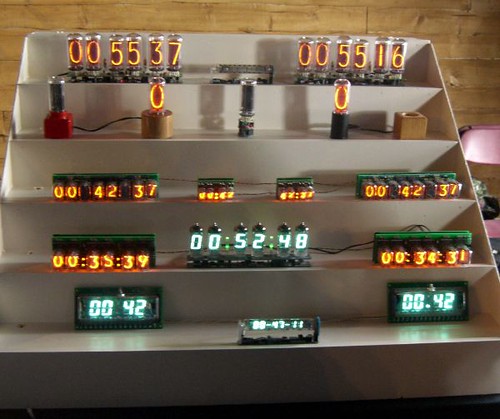
I just love nixie tubes. And this guys sells single tube clock kits. I think I buy one today.
Saturday, March 07, 2009
Makers in Brighton
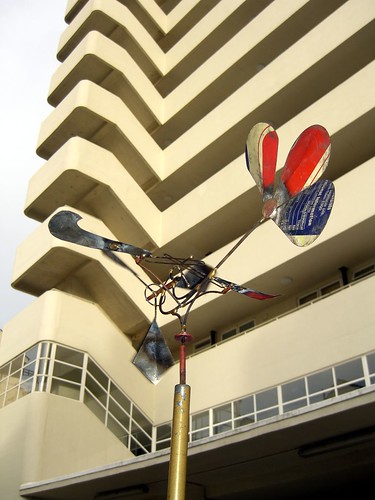
Today Row and I took a leisurely stroll across town for lunch at the Sanctuary (top little cafe and chill out space). Then we decided to check out a little art exhibition in the old boiler room of Embassy Court.
As we approached the gallery the way was crowded with glorious articulated geegaws, seemingly hewn from the sort of scrap that litters the dereliuct corners of town.
Inside the magical exhibition continued and there were some extraordinary musical sculptures too.
The guys behind the bizarre and magical windmill devices can be found at Circus Kinetica and I'm very keen to encourage them to come along to a Maker Faire at some stage.
Also very worthy of mention is the guy who is the main reason we ewent along at all- the very excellent and not at all short James Beasley- was doing live custom embroidery. Drawing quite a crowd too! James's work can be found at Alias Everything.
Tuesday, February 24, 2009
Archive Projects 'Flocking'- Timelines for All?
From time to time I realise that there is a tidal system at work behind the great institutions of this country and the wider world- it's not just economic cycles, though that's clearly a major factor, but also the social, the technical, and the political. At the moment this seems to be leading to a general resurgence in research into archives, and in particular, public access to them.
In the last week I've seen several completely unrelated demos and discussions of projects that seek to present harmonious, integrated and user friendly interfaces to a wide range of disparate archive assets, and what is striking is the congruence of 'vision' of the user proposition. Timelines! It's all about timelines!
As it goes the BBC has some pretty groovy timelines in service, but by and large these are exquisitly hand crafted pieces of digital interactive animation. The next generation of tools are going to have to give that same slick and accessible interface, but to widely heterogenous assets, sometimes from widely different sources! A timeline of the the next generation will need to provide access, meaningful access, to resources from across a broad federated archive, and include all manner of objects, including text, images, video and even 3d models for manipulation and exploration.
Within the BBC this is beginning to stretch beyond the relatively simple domain of linking web resources, into exploring how we can make the broad sweep of our online offering 'time taggable'. We are also contributing to JISC funded projects exploring how assets from us can be combined with others from archies, libraries and academic collections across the UK can be combined. This project is not universally welcomed- there have been objections to the threat of the BBC archive overwhelming other collections. We recognise these concerns and our current efforts in partnerships are very much focussed on bringing benefit to our fellow partners, and avoiding crowding out others. For one thing, we hope to help pioneer tools and technologies that will be then available to smaller archives for lower cost, because we and other 'big hitters' a
have made the initial research investment for the benefit of all.
For myself I do love a good timeline, but I do fear that the smoothness and accesibility of a graphical user interface is often at the expense of it's flexibility and power. Having said that- Gapminder demonstrates that power, flexibiliuty and beauty can be found together, if a clear idea of the user is maintained.
One last link: check out this Smashing magazine review of top graphical interface examples for Gapminder, BBC History and many more.
In the last week I've seen several completely unrelated demos and discussions of projects that seek to present harmonious, integrated and user friendly interfaces to a wide range of disparate archive assets, and what is striking is the congruence of 'vision' of the user proposition. Timelines! It's all about timelines!
As it goes the BBC has some pretty groovy timelines in service, but by and large these are exquisitly hand crafted pieces of digital interactive animation. The next generation of tools are going to have to give that same slick and accessible interface, but to widely heterogenous assets, sometimes from widely different sources! A timeline of the the next generation will need to provide access, meaningful access, to resources from across a broad federated archive, and include all manner of objects, including text, images, video and even 3d models for manipulation and exploration.
Within the BBC this is beginning to stretch beyond the relatively simple domain of linking web resources, into exploring how we can make the broad sweep of our online offering 'time taggable'. We are also contributing to JISC funded projects exploring how assets from us can be combined with others from archies, libraries and academic collections across the UK can be combined. This project is not universally welcomed- there have been objections to the threat of the BBC archive overwhelming other collections. We recognise these concerns and our current efforts in partnerships are very much focussed on bringing benefit to our fellow partners, and avoiding crowding out others. For one thing, we hope to help pioneer tools and technologies that will be then available to smaller archives for lower cost, because we and other 'big hitters' a
have made the initial research investment for the benefit of all.
For myself I do love a good timeline, but I do fear that the smoothness and accesibility of a graphical user interface is often at the expense of it's flexibility and power. Having said that- Gapminder demonstrates that power, flexibiliuty and beauty can be found together, if a clear idea of the user is maintained.
One last link: check out this Smashing magazine review of top graphical interface examples for Gapminder, BBC History and many more.
Sunday, February 22, 2009
beebcamp2
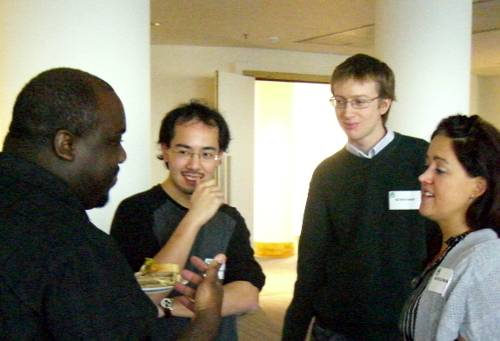
Last week saw the second Beebcamp held at Whitecity. Top kudos to Philip and all the organisers, and many thanks to all the invited contributors who came in and really added to the event.
For me one of the best things was bouncing the BBC Micro for the 21st Century ideas off a new crowd- there are at least two good leads now, outside of the BBC, for me to explore further, in addition to the existing ones.
And in other news, I got the promotion I was going for- Still not entirely sure of a start date (so much still to do on Avatar, including Vegas!), but I hope to soon in in the saddle so recently vacated by Matt Cashmore!
Saturday, February 07, 2009
Where Steam Punk was Born
Friday saw me in a facinating meeting with an EU technology research programme representative, and people from some of the most active research groups in the UK- that was great, but it's a topic for another day. Today's post is about the venue- the Institute of Mechanical Engineers- and their decorative stuff!
The I Mech E as it is usually called sits at the bottom southwest corner of St James Park, at 1, Birdcage Walk. A nice spot, tucked in behind the Foriegn and Commonwealth Office, very desirable. And our meeting was in the Whittle Room. The Frank Whittle room, Frank Whittle inventor of the jet engine and total engineering hero, and this room was absolutely stuffed with Whittle memorabilia- it was fantastic (and ever so slightly distracting when the gentleman from Brussels was explaining the finer points of the managment of conflicts of interest in proposal assesment schemes).
So that was completely brilliant, and then, on the way out, I notice that the hallway was lined (literally lined floor to cieling) with working model tractions engines. Working in as much as they could work if you fuelled them up etc- they were sitting in glass cases that day. All well and good you say, but this was to traction engines what the Natural History Museum is to bugs- this was the most incredible collection of the freaky, funky and downright weird traction engines that ever were. This then, in the heart of London, is clearly the true home of the Steam Punk ethic- the sanctum sanctorum of engineering mastery, the motherload of victorian gentle-person design and makery, and they know it!
The I Mech E as it is usually called sits at the bottom southwest corner of St James Park, at 1, Birdcage Walk. A nice spot, tucked in behind the Foriegn and Commonwealth Office, very desirable. And our meeting was in the Whittle Room. The Frank Whittle room, Frank Whittle inventor of the jet engine and total engineering hero, and this room was absolutely stuffed with Whittle memorabilia- it was fantastic (and ever so slightly distracting when the gentleman from Brussels was explaining the finer points of the managment of conflicts of interest in proposal assesment schemes).
So that was completely brilliant, and then, on the way out, I notice that the hallway was lined (literally lined floor to cieling) with working model tractions engines. Working in as much as they could work if you fuelled them up etc- they were sitting in glass cases that day. All well and good you say, but this was to traction engines what the Natural History Museum is to bugs- this was the most incredible collection of the freaky, funky and downright weird traction engines that ever were. This then, in the heart of London, is clearly the true home of the Steam Punk ethic- the sanctum sanctorum of engineering mastery, the motherload of victorian gentle-person design and makery, and they know it!
Friday, February 06, 2009
Maker Faire Newcastle 2009- Update
The deadline for getting your Maker proposal in is the 8th of Feb, this coming Sunday, so if you're going do let Josette know as soon as poss! The BBC has now commited to being there, and we have a cunning plan.... robots, weather, RFID, etc etc.
More to follow (maybe even a URL to the project!)
More to follow (maybe even a URL to the project!)
Subscribe to:
Posts (Atom)